When should you actually replace your spreadsheets?
I've built custom internal systems for over a dozen companies now. Almost every one of them started the same way: someone walks me through their operation, opens a shared drive, and shows me the spreadsheets. Lots of spreadsheets.
Client tracking in one file. Project timelines in another. Invoicing in a third. Revenue numbers in a tab called "Financials FINAL v3." Sometimes there's a mastersheet that tries to pull it all together. It usually doesn't.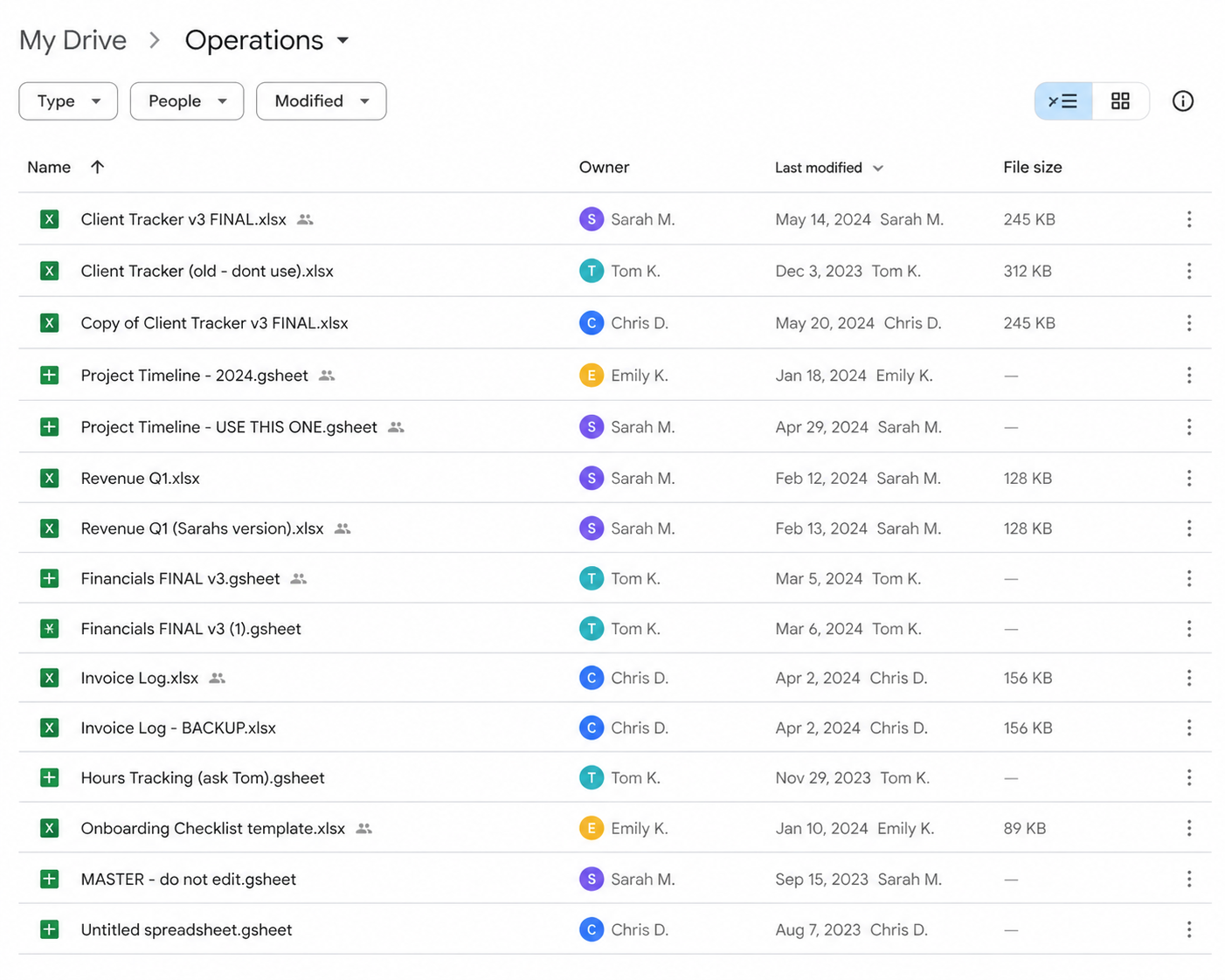
And every time, the question is the same: "Should we build something to replace all this?"
My answer is usually: not yet.
That surprises people. I'm the guy who builds the replacement. But after doing this enough times, I've learned that timing matters more than the software itself. Build too early and you waste money. Build too late and you've already lost people, clients, or both.
graph LR
  A[1-8 people\nSpreadsheets work] -->|team grows| B[5-15 people\nGetting messy]
  B -->|pain increases| C[15+ people\nToo late]
  C -->|should have been here| D[Right timing\nBuild it]
  style D fill:#059669,color:#fff,stroke:#059669
When spreadsheets are the right answer
Team of 1 to 8 people
At this size, don't build software. Don't buy SaaS. Stick with spreadsheets.
Your processes are still changing. How you track clients, run projects, invoice, none of that is settled. If you build a system now, you're locking in a workflow that'll be different in three months. You'll spend more time maintaining the tool than doing the work.
Most "spreadsheet problems" at this stage are really process problems. Or skill problems. Learn pivot tables, use data validation, build a proper template. Clean up how you work before you blame the tool.
And whatever you do, don't build something because you "might need it later." That later might never come. I've seen agencies spend months and serious money building a client portal nobody ended up using, because the process behind it was never figured out. The software was fine. The workflow wasn't there.
Software doesn't create process. It automates process that already works. If you haven't done the thing manually enough times to know exactly how it should flow, automating it just means you'll fail faster, or learn the hard way by rebuilding it three times.
A good process running on spreadsheets will always beat fancy software running on a bad process. Always.
When it gets messy (and why that's fine)
Team of 5 to 15 people
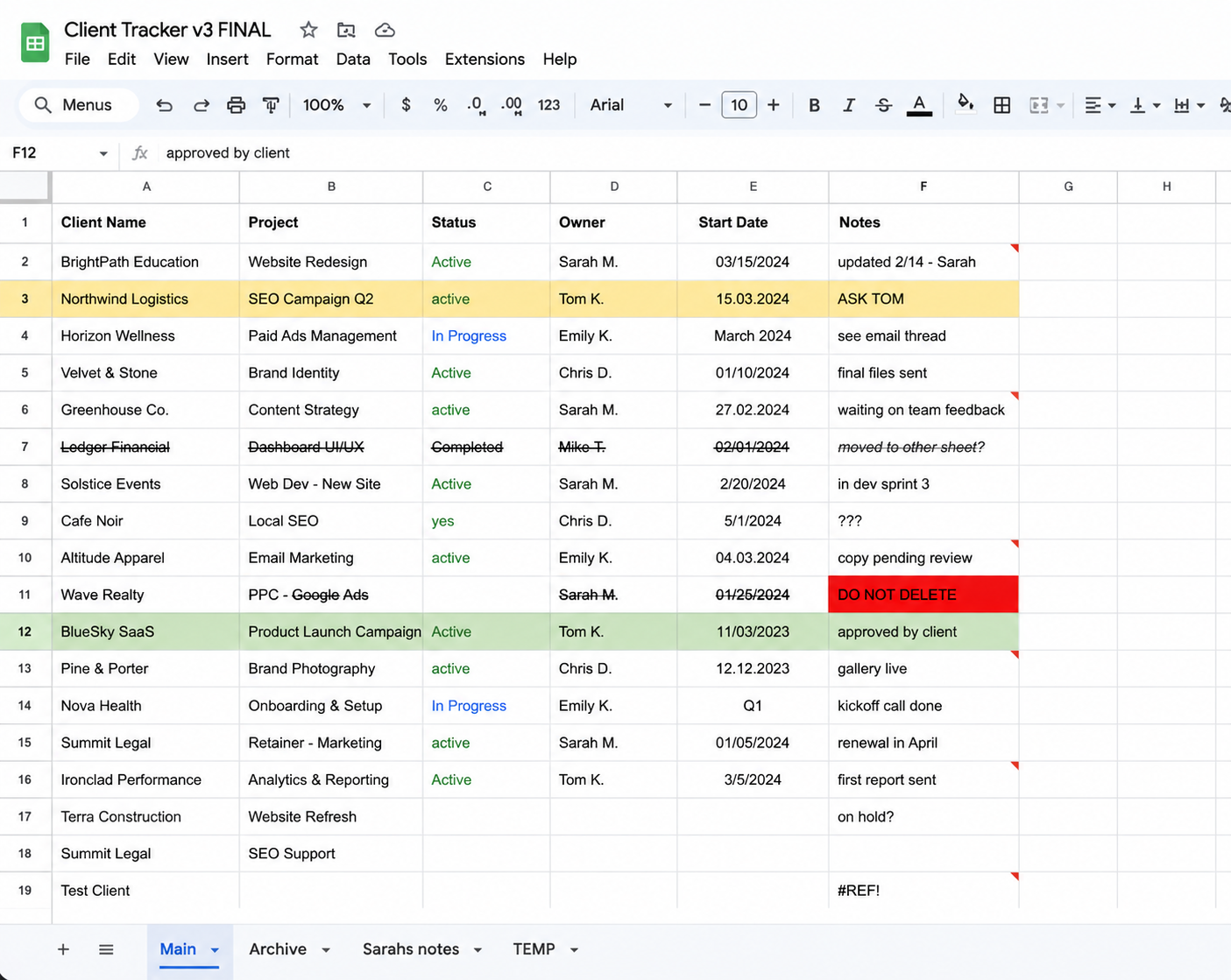
Somewhere around this size, things get uncomfortable. Multiple people editing the same file. Someone deletes a formula by accident. A new hire opens the shared drive and finds six files called "Client Tracker" with no way to tell which one matters.
You'll want to buy software. Hold off a bit longer.
The mess is actually useful. It's showing you exactly where your processes break down. Pay attention to it. Write down what data goes where, who updates what, when things fall apart. If you can't explain the workflow on a whiteboard, no software is going to fix it.
This awkward phase usually lasts 6 to 18 months. That's normal.
When you've waited too long
Team of 15+ (or 10+ with complex operations)
Most agencies figure out they should have switched about six months after they should have switched. The signs are obvious in hindsight:
Your project manager goes on vacation and nobody knows what's happening with their accounts. The spreadsheet is there, but nobody trusts it.
You have someone, maybe with the title "Operations Coordinator," who spends most of their week copy-pasting numbers between files. That's their job now. Copying and pasting.
A wrong number made it into a client report. An invoice went out twice. A deadline got missed because it lived on the wrong tab. These aren't hypothetical. They happened.
You bought Notion. Then Asana. Then Monday. Maybe Airtable too. Now the data is in even more places. The spreadsheets are still there. They're always still there.
New hires take two weeks before they can find anything. That's two weeks of salary spent learning where files live.
The cost of staying on spreadsheets is real at this point. It just doesn't show up as a line item. It shows up as slow work, quiet frustration, and mistakes nobody talks about.
When it's actually the right time
Three things need to be true at the same time:
Your process has been roughly stable for six months. Not perfect, but consistent. You know how a client moves from first contact to signed contract to active project. If the workflow changes every quarter, building software on top of it is a waste.
You can name the specific problem, with numbers. "Spreadsheets are messy" isn't enough. Something like: "We lose about 8 hours a week reconciling our project tracker with invoicing." Or: "Three clients got wrong reports last quarter because of copy-paste errors." If you can't quantify the pain, it's probably not bad enough yet.
You've outgrown the tool, not the process. If your process is broken, software just gives you a broken process with a nicer interface. But if the process works and you just can't run it reliably anymore because of the volume or the number of people, that's when custom software makes sense.
graph TD
  A{Process stable\n6+ months?} -->|No| B[Keep refining.\nDon't build yet.]
  A -->|Yes| C{Can you quantify\nthe pain?}
  C -->|No| D[Document it\nfor 1-2 months.]
  C -->|Yes| E{Outgrown the tool,\nnot the process?}
  E -->|No| F[Fix the process first.\nSoftware won't help.]
  E -->|Yes| G[You're ready.\nBuild it.]
  style G fill:#059669,color:#fff,stroke:#059669
What "custom" actually looks like
People hear "custom software" and picture a massive system that takes a year and costs six figures. That's not what we're talking about.
For a 15-person agency, it might be a single dashboard that replaces the five spreadsheets you use most. Or an automated workflow that moves client data between stages so nobody has to copy-paste. Or a portal where clients check their own project status instead of emailing you.
First version takes weeks, not months. You replace the most painful spreadsheet first, not all of them.
A quick gut check
Before spending money on this, ask yourself:
Has the core process been stable for at least six months? Can you put a number on what the current mess is costing you? Have you already tried just organizing the spreadsheets better? Is the problem the tool, or how people use it? Can someone on your team describe the ideal workflow from memory?
If you answered yes to all five, you're probably ready.
If you said no to any of them, you have cheaper problems to solve first.
Spreadsheets are great. They just have a ceiling. The hard part is knowing when you've hit it.
I help agencies figure out the timing and build the system when it makes sense. If you want to walk through your setup, I do a free 45-minute call where we look at what you have and talk honestly about whether you need anything different.